
Step 1
Build the grid
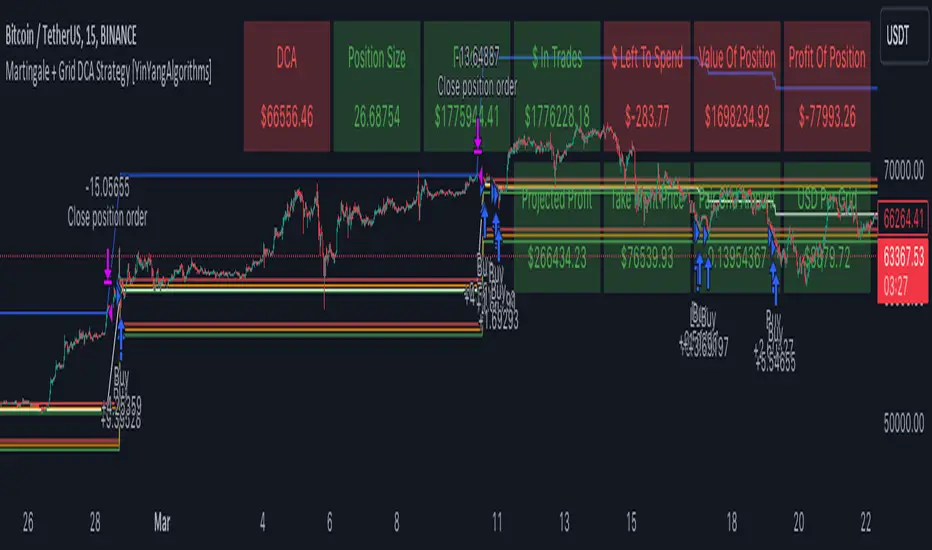
The strategy divides available capital across the configured grids. As price moves through grid levels, orders can stack so that one candle crossing several levels uses the corresponding combined allocation.
Build configurable Grid and Martingale DCA workflows through TradingView alerts and webhooks.
Overview
This strategy combines price-drop-based Martingale steps with purchase grids, configurable entry conditions, DCA tracking, and target-profit exits. It is the clearest demonstration of how a YinYang strategy can feed TradingView alerts into a compatible webhook execution service.
Configuration
Tutorial
Step 1
The strategy divides available capital across the configured grids. As price moves through grid levels, orders can stack so that one candle crossing several levels uses the corresponding combined allocation.
Step 2
A new Martingale grid is created after price falls the configured percentage from the current DCA. More aggressive sizing increases drawdown and capital risk; validate settings against realistic adverse scenarios.
Step 3
Choose from the publication’s EMA, RSI, MFI, highest-high, or lowest-low entry options, optionally evaluated on a different timeframe. The strategy closes when the documented target-profit condition is reached.
Step 4
A typical workflow is YinYang strategy → TradingView alert → webhook → compatible execution service. Confirm symbol mapping, order sizing, authentication, and failure handling in the external service before any live use.
Video tutorial
Strategy reports are historical and hypothetical. Results can change materially with symbol, timeframe, date range, settings, commission, slippage, liquidity, and execution conditions.
Martingale and grid methods can require substantial capital and can experience prolonged drawdown. They do not eliminate loss risk.
Signals, projections, and strategy outputs are analytical tools—not financial advice or guarantees of future results. Trading involves substantial risk.
No numerical performance claim is presented here because symbol, timeframe, tested date range, settings, commission, and slippage must be shown together. Review those parameters inside TradingView before interpreting any strategy report.
This guide is a rewritten YinYang overview. For the author’s complete source description and release notes, view the original publication.
Related scripts
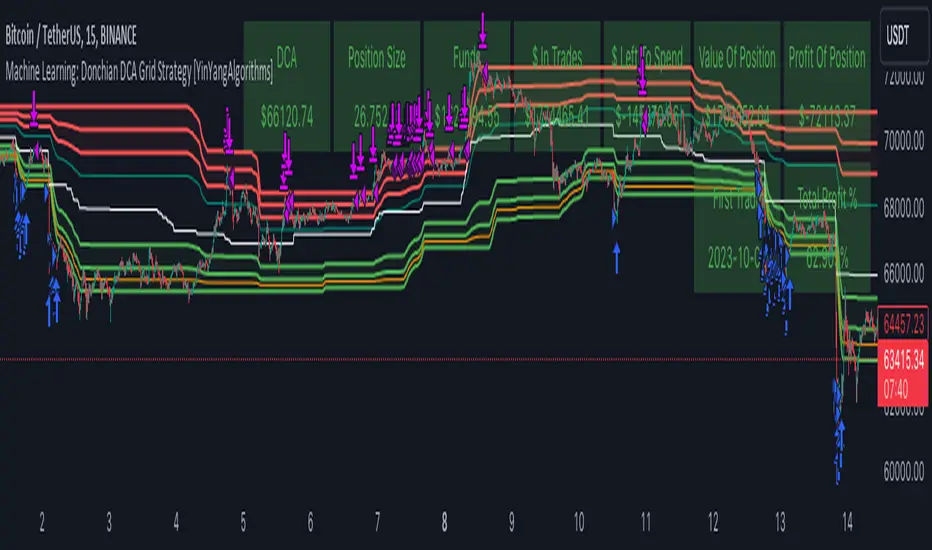
A data-driven spot DCA strategy designed to accumulate lower and exit systematically.
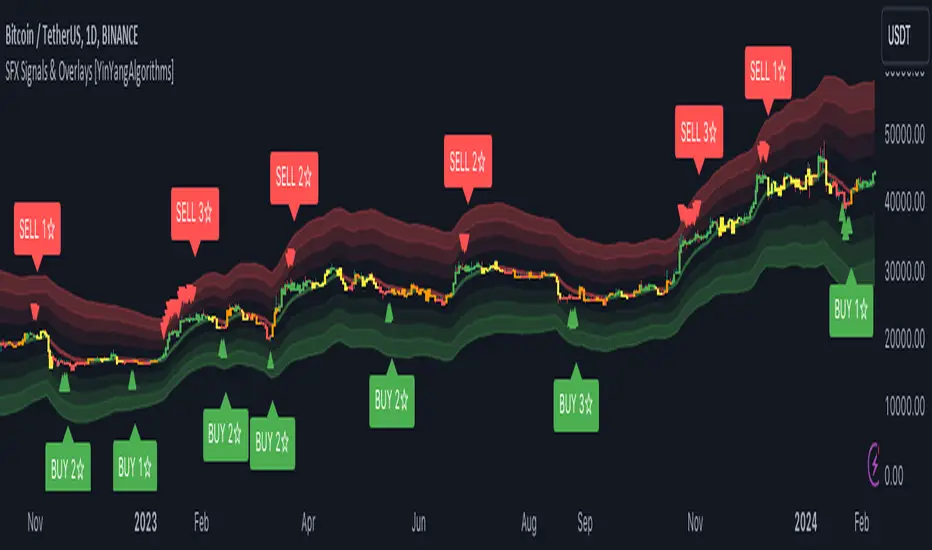
Signals, structure, momentum, and market zones in one configurable toolkit.
Ultimate combines the web analytics platform with all six featured invite-only TradingView tools.
TradingView® is a trademark of TradingView, Inc. YinYang Algorithms is not affiliated with or endorsed by TradingView. A separate TradingView account is required; paid TradingView plans are not included.